Yara Walter · 18 September 2026
Tracing the Evolution of Tagging Systems and Their Influence on Information Retrieval in Digital Notebooks
Early Foundations of Tagging in Personal Knowledge Tools
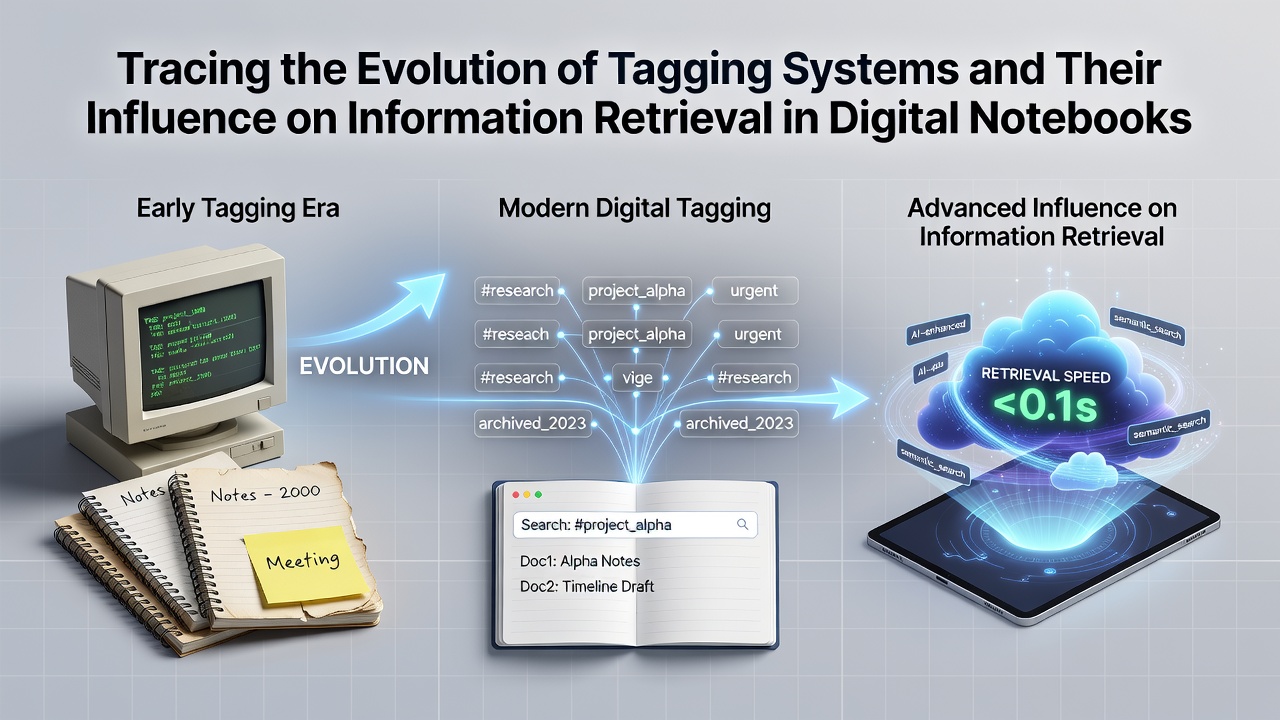
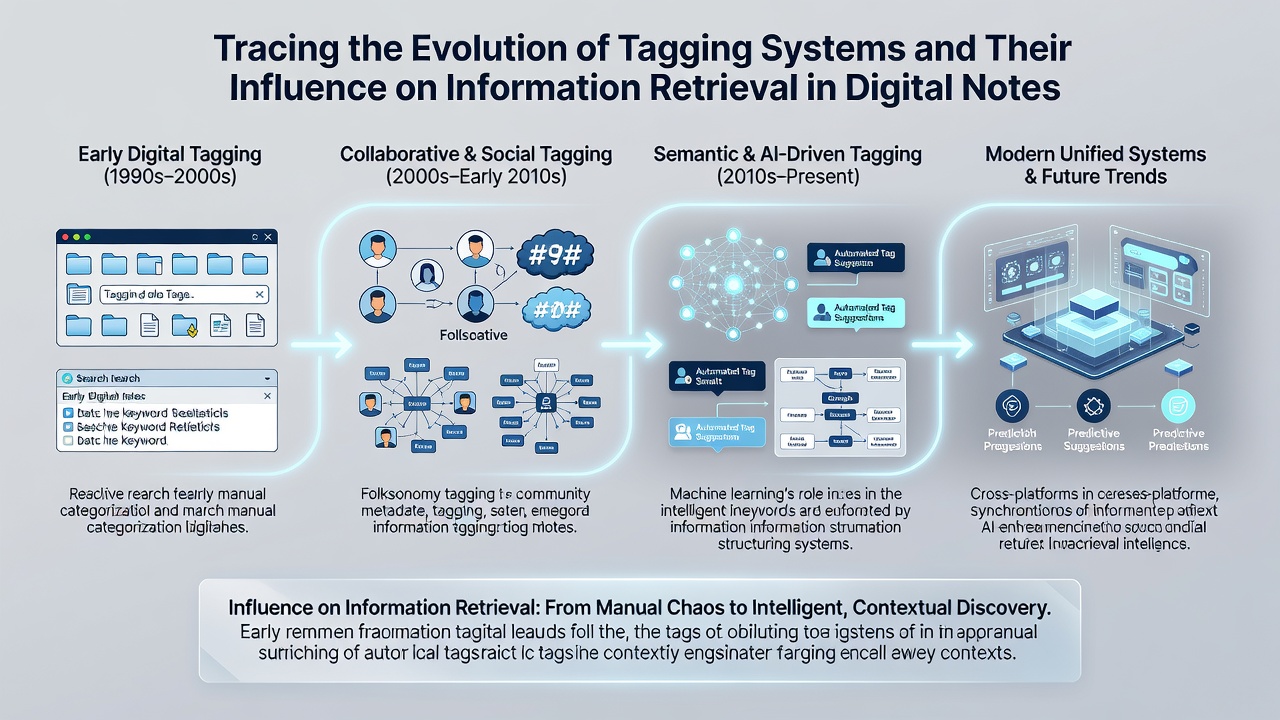
Tagging systems emerged in the late 1990s as users sought flexible ways to organize growing volumes of digital information, and researchers documented how these methods moved beyond rigid folder structures toward user-defined keywords that linked related items across different contexts. Systems like early blog platforms and social bookmarking sites demonstrated that tags could create emergent categories through collective use, while individuals applied similar approaches in personal note-taking software to retrieve scattered thoughts without predefined hierarchies.
By the early 2000s, applications such as Evernote introduced tagging as a core feature that allowed users to assign multiple labels to a single note, and data from that period showed improved retrieval speeds when people searched by tag combinations rather than folder paths alone. Studies from institutions including the University of Toronto indicated that these methods reduced cognitive load during information lookup tasks because tags supported associative rather than linear navigation.
Shift Toward Folksonomies and Semantic Connections
Folksonomies developed when users collectively applied tags without centralized control, and this pattern influenced how digital notebook developers designed retrieval algorithms to surface notes based on overlapping labels. Platforms incorporated tag clouds and autocomplete suggestions that reflected actual usage patterns, while integration with full-text search expanded the range of discoverable connections. Observers noted that retrieval accuracy increased when tags captured contextual details such as project names or themes that might not appear in the note text itself.
Integration with Modern Notebook Platforms
Applications like Notion and Roam Research advanced tagging by linking notes bidirectionally through embedded references that functioned similarly to tags yet preserved explicit relationships, and this evolution allowed retrieval systems to traverse networks of ideas rather than isolated keywords. Data from platform analytics revealed higher engagement rates among users who combined tags with graph-based views because such combinations surfaced previously overlooked connections during research or writing sessions. In September 2026, several notebook services rolled out enhanced tag analytics that visualized usage trends over time and suggested refinements based on retrieval history.
Academic investigations conducted at the Australian National University examined how tagging influenced long-term information retrieval in educational settings, and findings indicated that students who maintained consistent tag vocabularies located course materials more efficiently than those relying solely on search strings. Government reports from Canadian digital innovation programs further highlighted that tagging reduced duplication of stored content because users could reference the same note across multiple projects without creating copies.
Impact on Search Algorithms and User Behavior
Retrieval engines within digital notebooks began incorporating tag frequency and recency signals to rank results, and this adjustment reflected observed user patterns where recently tagged items often represented active work. While hierarchical folders persisted in many tools, their role diminished as tagging allowed cross-cutting organization that folders could not easily replicate. Those who studied these transitions recorded that retrieval precision improved when algorithms weighted tags alongside metadata such as creation dates and modification history.
Industry analyses from the European Association for the Study of Science and Technology documented measurable gains in productivity metrics after organizations standardized tag taxonomies across team notebooks, and the same reports noted that inconsistent tagging sometimes introduced noise that complicated searches until moderation features were added. Users adapted by developing personal conventions that balanced specificity with breadth, which in turn shaped how software interfaces presented tag suggestions during note creation.
Conclusion
Tagging systems have progressed from simple keyword labels to sophisticated components of information retrieval architectures in digital notebooks, and this progression continues to shape how individuals and teams locate and connect stored knowledge. Ongoing refinements in tag management tools and retrieval algorithms build on decades of documented usage patterns across diverse platforms and user groups.