
Carlo Berger · 2 October 2026
Analyzing Voice Transcription Accuracy and Its Role in Accessibility Enhancements Across Digital Note Platforms
Voice transcription technology converts spoken words into text within digital note platforms, and accuracy rates have climbed steadily as machine learning models process diverse accents alongside background noise. Data from industry reports shows that leading systems now reach 95 percent accuracy under controlled conditions, yet real-world variables such as overlapping conversations or specialized terminology continue to affect results. Researchers track these metrics across platforms like Evernote, Microsoft OneNote, and Google Keep because transcription errors directly influence how users with visual or motor impairments rely on the tools for daily documentation. Platforms integrate these features to meet accessibility standards that require equivalent access to information. The European Accessibility Act outlines requirements for digital services, and developers adjust transcription engines to align with those benchmarks. Accuracy improvements matter here since users who depend on screen readers encounter garbled text when speech recognition falters, which disrupts workflow and reduces productivity. Observers note that October 2026 brought firmware updates to several major note applications, incorporating refined language models trained on medical and legal vocabularies that previously caused frequent substitutions.Factors Influencing Transcription Precision
Multiple elements determine how well voice input translates into usable notes. Audio quality ranks first because microphones in consumer devices vary widely in sensitivity, and distant speakers introduce distortion that algorithms struggle to resolve. Accent recognition follows closely since training datasets have expanded to cover regional dialects from North America, Europe, and Asia, although less common linguistic patterns still produce higher error counts. Studies indicate that context-aware processing reduces mistakes by analyzing surrounding words rather than treating each term in isolation.
Platforms apply noise cancellation and speaker diarization to separate multiple voices during meetings, and these steps raise reliability when users record group discussions. Data shows that post-processing corrections, where the system flags low-confidence segments for user review, further boost final accuracy without requiring constant manual edits. Those who have examined error logs across applications find that punctuation insertion and capitalization remain weaker areas compared with word recognition itself.Accessibility Benefits in Practice
Users with disabilities gain concrete advantages when transcription functions reliably. Individuals who cannot type due to repetitive strain injuries or limited mobility dictate notes that appear instantly on screen, and this capability supports independent work without reliance on assistants. Screen reader compatibility improves when text is clean because synthesized speech flows naturally rather than stumbling over misheard terms. Government agencies in Canada have documented how accessible note-taking tools reduce barriers in educational settings, allowing students to capture lectures without visual dependence.
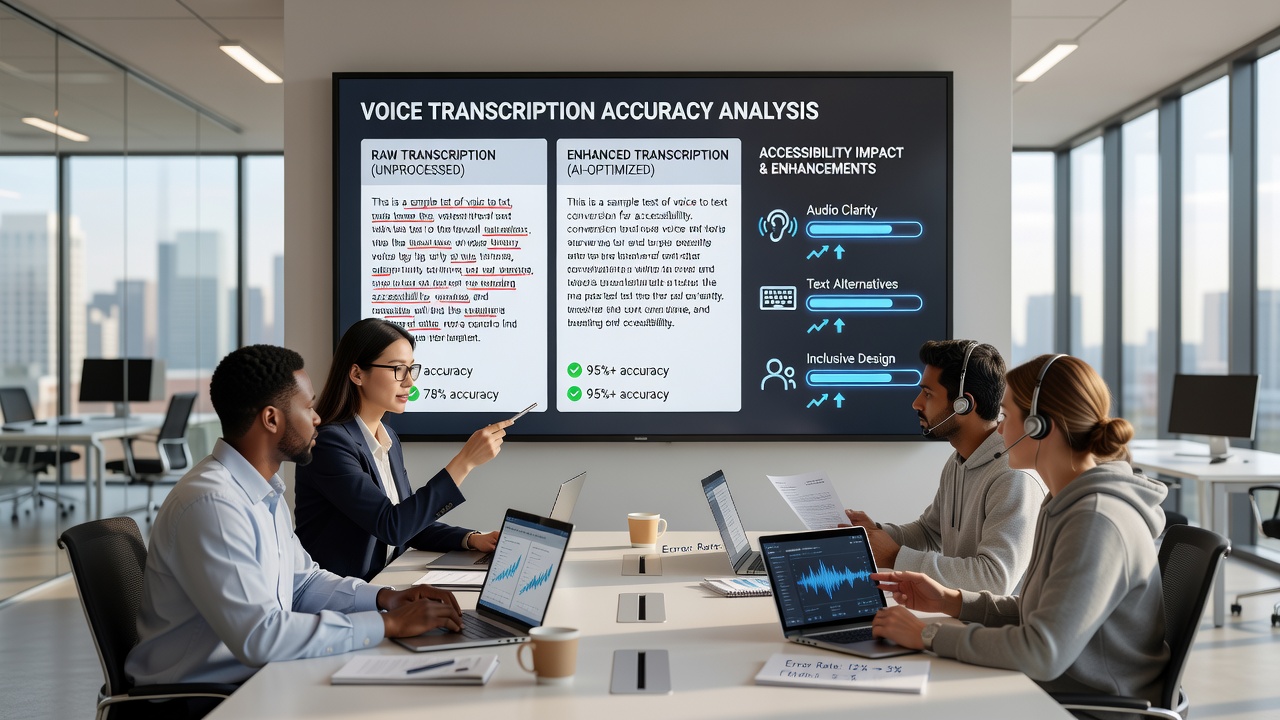 One case involved researchers evaluating transcription in academic environments where lecture halls produce reverberation that lowers baseline accuracy, yet platform updates in late 2025 incorporated directional audio processing that restored much of the lost performance. The result allows note platforms to serve broader populations while complying with emerging digital accessibility directives.
Comparative Performance Across Platforms
Accuracy benchmarks differ by application because each company maintains proprietary datasets and model architectures. Microsoft OneNote benefits from deep integration with Windows speech services that leverage extensive enterprise usage data, while Google Keep draws on web-scale training to handle informal language patterns. Evernote emphasizes offline capabilities with lighter models that trade some precision for functionality in low-connectivity areas. Figures from independent testing reveal that hybrid approaches combining on-device and cloud processing achieve the strongest balance between speed and correctness. Developers continue refining these systems through user feedback loops where corrections feed back into training sets, accelerating adaptation to new terminology. Observers tracking adoption rates note that platforms offering granular control over language selection and domain-specific dictionaries see higher retention among accessibility-focused users.
Regulatory Context and Future Developments
Standards bodies worldwide update guidelines to reflect advances in voice technology, and compliance drives platform investment. The U.S. Access Board provides technical assistance on electronic information accessibility, and its resources help developers align transcription features with Section 508 requirements. In parallel, academic institutions publish studies that quantify error rates across demographic groups, highlighting remaining gaps for non-native speakers or those using technical jargon. These findings push companies to diversify training data further. October 2026 marked the rollout of updated APIs in several note platforms that expose confidence scores to third-party accessibility extensions, enabling custom verification workflows. Such changes expand options for users who combine multiple tools rather than relying on a single application.
Conclusion
Voice transcription accuracy directly shapes how effectively digital note platforms support accessibility goals, and ongoing refinements in model training continue to narrow performance gaps. Data from regulatory sources and research institutions demonstrates measurable progress, while platform-specific implementations reveal varied strengths that users evaluate based on their individual requirements. Continued attention to real-world conditions ensures these tools deliver reliable text output that broadens participation across diverse user groups.